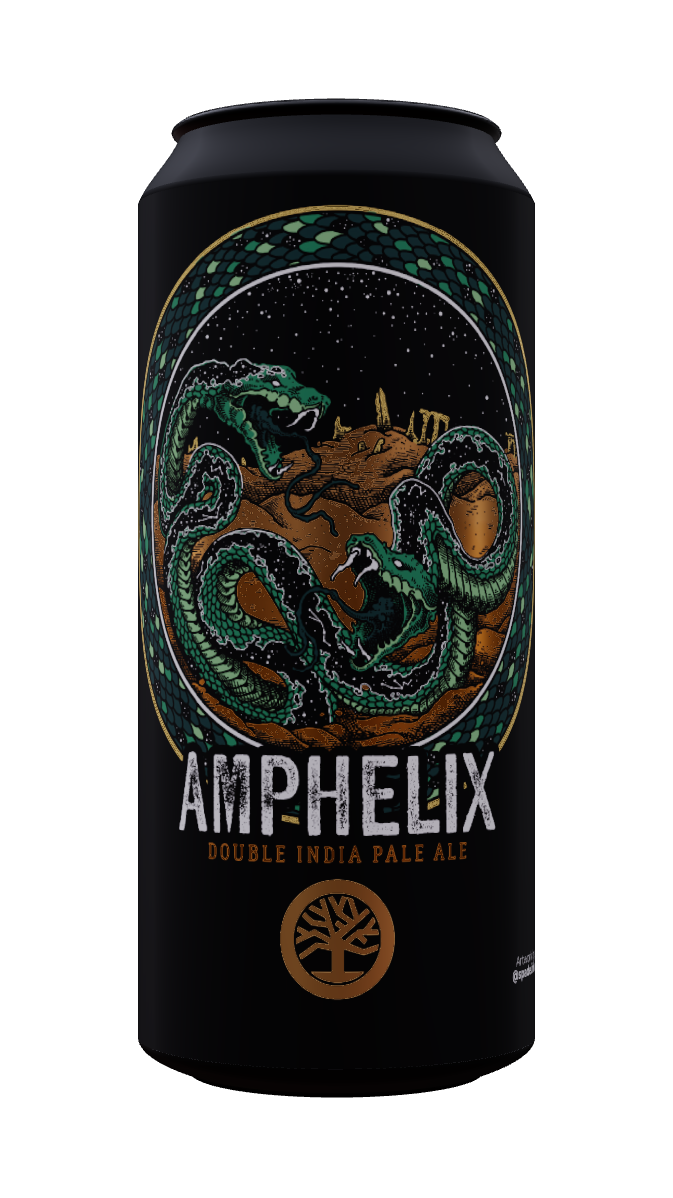
A double helix of tropical venom spiraling through the glass. Peach, lemon, and lime coil through a dangerously potent frame. Modern in method, ancient in its serpentine, double-strength power.
When Perseus severed the head of Medusa, her blood fell upon the Libyan sand and from that blood, according to the Roman poet Lucan, sprang the serpents of the desert. Among the vipers, asps, and cobras born from the Gorgon’s gore, one creature was stranger than all others: the amphisbaena, the serpent with a head at each end. It could move forward or backward with equal speed and equal intent. It never needed to turn around. It never needed to retreat. Every direction was an attack.
The amphisbaena fascinated the ancient world. Pliny the Elder cataloged it in his Natural History. Isidore of Seville described it in his Etymologies. Medieval bestiaries illustrated it as a serpent biting its own second head, forming a hoop that could roll across the ground with terrible momentum. The creature embodied a specific fear: that some dangers have no safe approach. You cannot circle behind an amphisbaena. There is no behind. Every angle of approach meets fangs.
The deeper mythology is one of duality. The amphisbaena does not choose a direction. It exists in both simultaneously. It is the creature of thresholds, of contradictions held in a single body. Sweet and bitter. Beautiful and venomous. Forward and backward at once. The coiling of its twin-headed body is the original helix, the spiral form that nature returns to again and again, from the twist of a ram’s horn to the whorl of a galaxy.
Amphelix is that two-headed serpent poured into a glass. A Double India Pale Ale at 8.7% ABV, it coils with peach, lemon, and lime through a frame dangerously potent enough to justify the mythology. It moves in two directions at once: lush tropical sweetness spiraling against clean, cutting bitterness, and both heads strike at the same time. Approach from any angle. The result is the same. You will not see the second head until you have already been bitten.